Why Now
The First Generation to Live 100 May Already Be Here.
A child born today may inhabit a world at 80 that we cannot possibly imagine. We shouldn't pretend we know exactly what medicine will look like then — but we can prepare that child to benefit from it.
AI
Models that can read a lifetime of health data and find trajectory, not just abnormality.
Genomics
Falling costs turning sequencing into a routine input rather than a rare event.
Diagnostics
Multi-cancer early detection and advanced imaging moving disease discovery years earlier.
Wearables
Continuous physiology at consumer scale — sleep, cardiovascular, metabolic, activity.
Biotechnology
AI-designed therapeutics compressing development timelines.
Regenerative medicine
Tissue repair, cell therapies and organ preservation maturing.
Cellular reprogramming
Research targeting mechanisms of biological aging itself.
Precision medicine
Treatment selected by biology rather than by population averages.
Robotics
Physical assistance that extends independence at home.
Preventive medicine
A slow shift from treating disease to managing risk.
Continuous monitoring
Health as a stream of information rather than an annual snapshot.
The strategic argument
Technology is accelerating faster than the institutions designed to help people use it.
Scientific breakthroughs mean little if ordinary people cannot understand them, afford them or reach them. Life100+ intends to become that organizing layer — the bridge between longevity discovery and everyday human life.
~670,000
People age 100+ today
A rounding error in global population — and a number that may not stay small.
8–10M
Conventional-medicine scenario, 2075
Diseases treated better; aging itself largely unchanged.
50–100M+
Age-reversal scenario, 2075
Damage repaired and biological age reduced. Illustrative scenario, not a prediction.
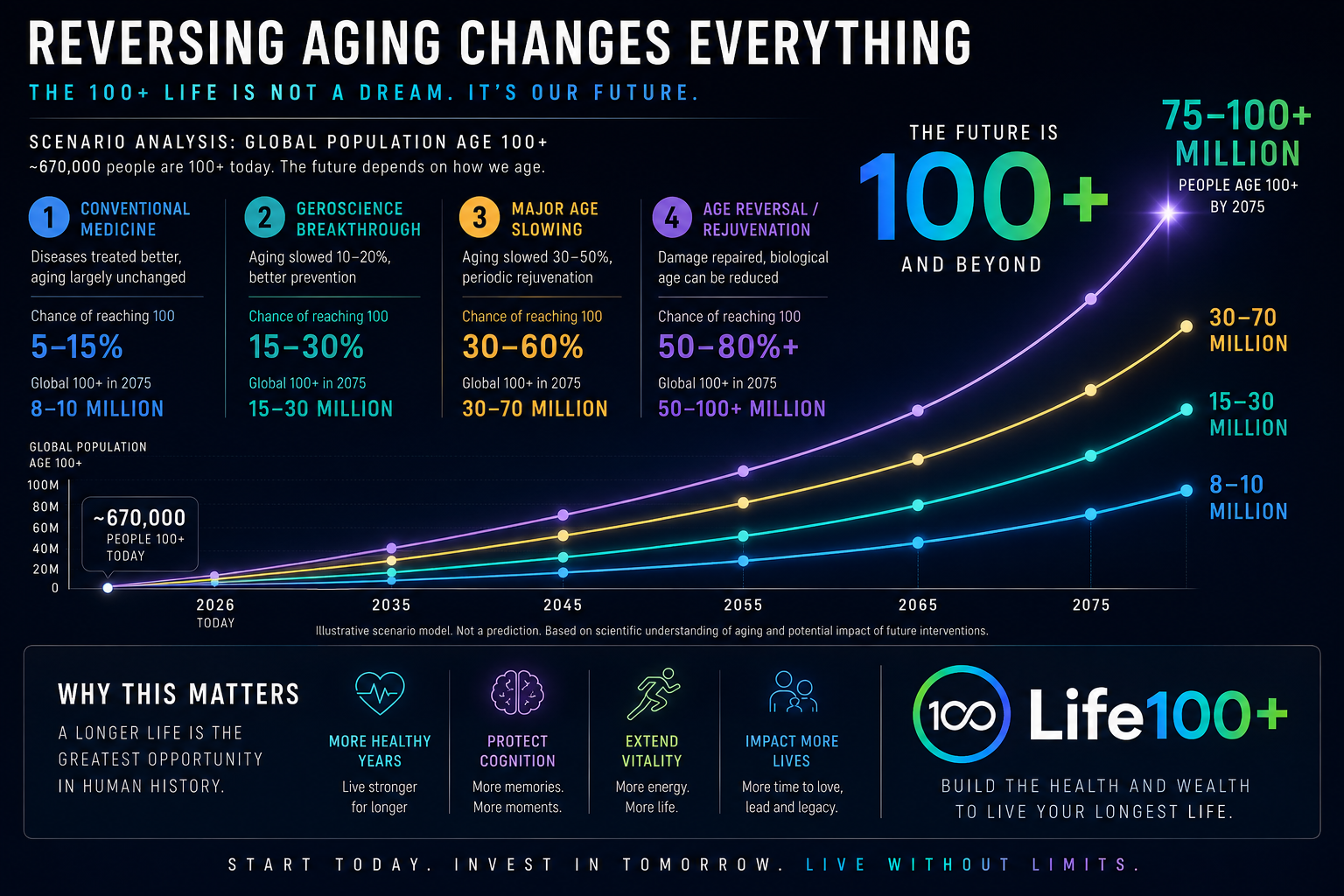
Illustrative scenario model. Not a prediction. Based on scientific understanding of aging and the potential impact of future interventions.
Why we're building it